Shielding Your Brilliance: Practical Steps for Small Business IP Protection

Creativity and innovation are often the driving forces behind small business success. Whether it’s a unique product, a catchy brand name, or proprietary technology, your intellectual property (IP) is the essence of what sets your business apart.

However, with the rewards of creativity come the risks of infringement. Keep reading to explore how small business owners can identify, safeguard, and defend their intellectual property against infringement.

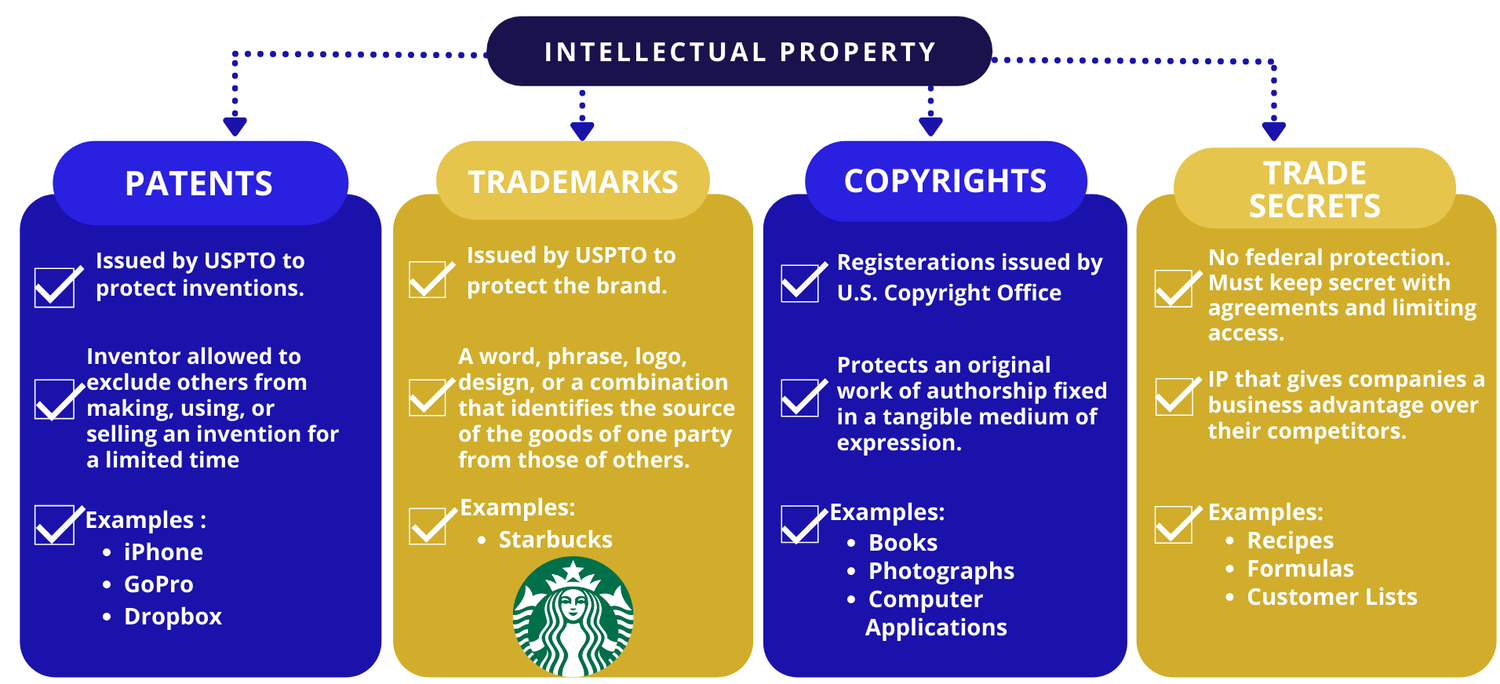
At the heart of intellectual property lie patents, trademarks, copyrights, and trade secrets. Each category protects different aspects of your creative work, from inventions to branding elements to original content. Understanding these categories is crucial for small business owners looking to safeguard their ideas and assets.

Identifying IP Infringement

The first step in protecting your intellectual property is recognizing when it’s being infringed upon. What does infringement look like? Maybe it’s the unauthorized use of your brand name or logo, replication of your copyrighted content, imitation of your patented inventions, or breach of your trade secrets. Being vigilant and proactive in monitoring for such infringements is key to preserving the integrity of your IP.

Taking Action

Here’s one of the not-so-fun parts of running a business: having to deal with someone using your intellectual property without permission or payment. It’s essential to take proactive steps to protect your IP. Those steps include:

  • Obtaining legal protection through trademarks, copyrights, and patents;

  • Drafting clear contracts to establish ownership rights and implementing robust security measures to safeguard trade secrets;

  • Conducting regular IP audits to assess and document your assets;

  • Maintain meticulous records of your creative process, including drafts, timestamps, and invention dates.

  • Set up online alerts to track mentions of your brand name or products. Not everything will rise to the level of infringement, but early detection is crucial.

Building a Culture of IP Awareness

Ultimately, protecting intellectual property requires more than just legal safeguards for your IP assets—it requires a culture of awareness and respect within your organization. Starting at the head, as a business owner focus on innovating, and if you are “inspired by”, be careful not to copy and just make slight changes. That is a No-No.

Also, educating employees on the importance of IP protection, promoting ethical practices (i.e. not misusing or copying IP), and encouraging innovation while emphasizing the need for confidentiality are essential steps in fostering a culture that values and protects creativity. Anyone that is part of your team should understand the steps they need to take if incorporating another creator’s IP in the deliverable.

When the Gloves Come Off

If you suspect infringement, don’t stay silent. If you are accused of infringement, don’t ignore. Consulting an IP lawyer can help you navigate the legal complexities of infringement and determine the best course of action.

In the competitive landscape of small business, intellectual property is both a precious asset and a potential liability. By understanding the various forms of intellectual property, identifying potential infringements, implementing robust protection strategies, and fostering a culture of awareness and respect, small business owners can safeguard their creative assets and ensure their long-term success. Remember, defending your creativity isn’t just about protecting your business—it’s about preserving the essence of what makes it unique.

MC Law offers various solutions to help you protect and monetize your IP. Get in touch with us here today!


Mine / Yours: Understanding the Ownership of Intellectual Property in the Workplace

A client recently reached out about a new law labor in NY that addresses intellectual property developed by employees (BTW if you have burning business or IP questions, feel free to send an email).

To put it simply, New York Governor Kathy Hochul has just signed a law that says employees do not have to give their employer any rights to an invention they create on their own time, using their own material, unless it’s related to what the company does and was created while they were working for the company[1]. This new law validates the usual terms found in most employment contracts.

Are you currently working for someone while building your business on nights and weekends? Do you know what that means for your inventions or anything else you are creating while employed? This blog is all about ownership.

Inventions? Is it mine or yours?

First things first, let’s clarify what we’re talking about. When we mention “inventions,” we mean those brilliant, world-changing ideas and creations that may spring to life during your personal time if you are an employee.

This could be anything from a new app, a game-changing invention/product for children, or even the next best-selling novel. Now, when it comes to “employee rights,” we’re addressing the question of who owns these inventions.

The General Rule

In general, if you develop an invention in your own time, using your resources, and without using any of your company’s equipment, trade secrets, or confidential information, the invention is likely to belong to you.

Why Should You Care?

You might wonder why this matters, especially if you are currently employed and thinking “how will they know what I’m creating in my personal time?”

Well, understanding these rules is crucial for both employees and employers. For employees, it means they can explore their creative side without worrying that their nights and weekend project could be claimed by their employer. It encourages innovation, creativity, and entrepreneurship.

For employers, it means setting clear expectations and providing transparent policies. If you’re worried about potential conflicts of interest or if you think your employee’s invention could be related to your business or industry, it’s crucial to establish ground rules from the start.

Not So Fast

Of course, there are exceptions to this rule. Similar to the new NY law, some employment contracts may have clauses that grant the employer rights to inventions or other intellectual property created outside work hours, especially if those inventions or IP are related to the company’s business. That’s why it’s crucial for both parties to review and negotiate employment agreements carefully.

A great practice for employers and employees alike is to discuss these matters when the employer makes the offer of employment, and the employee negotiates the terms of the employment agreement presented. Open communication can help avoid misunderstandings and conflicts down the road. And for employers, it’s also a chance to showcase your support for your employees’ creative endeavors.

However, if you’re an employer who wants to assert some ownership over inventions created outside of work hours, there are ways to go about it:

  1. Make sure your employment contracts specify the company’s rights (especially if you are in a state that has not made this law) to inventions and any exceptions for creations developed outside work hours.

  2. If you’re dealing with particularly valuable inventions, you might want to consider a separate agreement to define the ownership, revenue sharing, or royalties.

  3. Open Dialogue: Encourage employees to come forward with their inventions. If an idea has the potential to benefit the company, discuss it openly, and find a mutually beneficial solution.

Over the last decade it has become more common for individuals to work for someone full-time and have a side venture to make more money or work full-time and build their business on the side until they have the funds to make the leap into full-time entrepreneurship.

It’s also not uncommon for individuals to go from employment to entrepreneurship and back to employment. With all the ways in which we now earn a living, it’s important that on whatever side you sit, you understand employee rights as they relate to intellectual property.

Remember, if you are an employee, the key here is to understand the parameters of what you can create and fully own within the context of your role as an employee. This is especially important if you are considering leveraging your current position to create a new business.

If you’re an employer, remember to respect your employees’ creative freedom while also protecting your company’s interests. Open communication and transparent agreements can go a long way in creating a win-win situation for everyone.

Stay creative, stay innovative, and stay informed!

What You Need to Know About Infringement: Part Two

In Part One, we looked at infringement from a copyright perspective. We discussed how to stop infringers and how to avoid becoming an infringer. And we rounded out our discussion by reviewing a few common defenses to copyright infringement claims.

Part Two is all about trademark infringement. To recap, trademark infringement is the unauthorized use of another’s trademark that leads to public (potential customers) confusion as to the actual company producing the product or delivering the service.

STOPPING INFRINGEMENT

Protecting your Brand

The obvious first step is to secure your trademark. While the U.S. is the first to use a trademark system, it would be a mistake to not prioritize applying for a trademark. You don’t want to let three or four years pass, then decide to apply, and find a pending trademark that is the same or similar to your trademark.

At that point you would have to (1) consider rebranding, (2) challenge the pending trademark application if you can prove that you were using the trademark in commerce first or, (3) petition to have the trademark registration cancelled if you can prove you have superior rights.

Whatever option is best for you, you will likely lose sleep and spend more than if you had invested in applying for the trademark at the beginning.


Monitoring

Receiving that registration certificate from the USPTO is just the start. It’s up to you to monitor the use of your trademark. This may be news to some, but the USPTO will not monitor and stop infringers on your behalf. The USPTO will not alert you if someone starts using your slogan. The USPTO will not monitor social media and websites for you.

Once you have the registration certificate in hand, its important that you use the trademark as described in the registration, AND its your responsibility to monitor for misuse. Monitoring for you may include setting up Google alerts or blocking time on your calendar to search social media and the USPTO for pending applications.

Handling your Business

You’ve registered. You monitor consistently (or hire us to help) and found someone misusing your trademark or plain copying your trademark. Best case scenario, you never have to head to court, and with your registered trademark in hand, you can stop the infringement with a cease-and-desist letter sent to the infringer.

The cease-and-desist letter would assert that you are the rightful trademark owner and demand the immediate end of the infringement. But if the infringement continues, with a registered trademark, you have a legal presumption that you own the trademark which, similar to what we covered in Part One, is critical if you need to head to federal court.

The goal of bringing a lawsuit is to (1) stop the infringement and (2) seek damages for the loss suffered by your business.

HOW TO AVOID INFRINGEMENT?

Search, Search, and Search. For some of us, coming up with brand names that perfectly captures the feelings we want to evoke in our target customers that’s memorable, and that stands the test of time, is not easy.

So you go through brainstorming sessions, write down your ideas, conduct surveys, ask family and friends for their input, until you land on the “perfect” name.

Before you spend time and money on creating logos, developing a marketing campaign, and securing the social media handles, you will want to conduct a thorough search to make sure your name does not infringe on an existing trademark.

Remember, the fact that you did not find someone using the exact name does not mean you are free from an infringement claim.

DEFENSES TO INFRINGEMENT

Now, before you go after someone or strike a name from your list because you don’t want to get hit with a cease and desist, you should know that determining whether the use constitutes infringement requires careful consideration.

If you’re curious, you can do a deeper dive and take a look at the 8 Factor Trademark Infringement Test that courts use when reviewing a trademark infringement claim.

Here, I want to focus on two of the factors based on what I encounter and questions I receive from clients using the following example:

A portion of your trademarked slogan is emblazoned on a t-shirt, one of many styles in an online store. And your trademark was registered in connection with your startup business coaching services only.

  1. The marks are not similar: Assuming your mark does not contain a completely made-up term, you have to consider the marks in their entirety, not in its separate features.

  2. The goods or services are unrelated: Remember, your registration grants you the exclusive right to use your trademark in the classes that represent the goods or services you offer to the public. It’s not a blanket right.

So in our brief example, a portion of a slogan on apparel sold at an online apparel store is unrelated to a business coaching service.

Just like with copyrights, when it comes to trademarks, the facts matter when making a determination of infringement. Check out our Intellectual Property page for more information on how we help you protect your intellectual property.

It’s always better to prevent a problem than to fix a problem. Put yourself in the best position to protect and maximize your IP.

Feel free to reach out to us for a consultation to get started on protecting your intellectual property.

What You Need to Know About Infringement: Part One

“Do I need permission to use the images I found on google on my website or in my artwork?”

“What if someone used my trademark (word mark) in their post?”

“Can I post or sell my parody of a popular song?

It depends. Entrepreneurs, and rightfully so, should be thoughtful about what they include on their websites, use in their digital marketing, or what they can include in the products they sell.

Likewise, since it’s an owner’s duty to monitor the use of their intellectual property, they should be mindful of what rights they have and how far they can go to protect those rights and stop infringement.

When it comes to intellectual property and specifically infringement, entrepreneurs and business owners are responsible for two things: (1) making sure they (as well as their contractors, employees, or other vendors) do not infringe on the rights of others, and (2) monitoring and identifying when their rights have been infringed upon.

In basic terms, intellectual property infringement is the unauthorized use of an another’s intellectual property rights. For our purposes, I will focus on trademarks and copyrights (in two parts – starting with copyrights).

  1. Trademark infringement is the unauthorized use of another’s trademark that leads to public (potential customers) confusion as to the actual company producing the product or delivering the service.

  2. Copyright infringement is the unauthorized reproduction, distribution, performance, and public display without the permission of the copyright owner.

Stopping Infringement

In the U.S. you become a copyright owner as soon as your original work is fixed in a tangible medium of expression.

For example, you own the copyright to the book you’ve written (not the idea for the book) even before it’s published, sold, or registered with the Copyright office. U.S. copyright law provides copyright owners with the right to make copies, prepare derivative works, distribute copies, perform publicly, display publicly, and authorize others to exercise these rights.[1]

However, if you need to sue an individual or a business for copyright infringement and ultimately want to receive damages, you will need to have a registered copyright with the U.S. Copyright Office.

So, while not mandatory, it’s best to register your copyright before the need arises. If the time comes that you need to enforce your rights, the copyright registration serves as proof that you are the rightful owner, and the alleged infringer would then have the burden of demonstrating that they have not violated your rights.

More importantly, if you win your case, you may be entitled to civil statutory damages, fines, and attorneys’ fees.

Let’s take a step back.

When you become aware that someone is infringing upon your copyright, the first step is to advise the other party that you are the rightful owner and request that they cease and desist from using your work. We can help with that.

If the alleged infringer ignores your request, you have options including resolving the dispute before the Copyright Claims Board (CCB) if your claim is for damages up to $30,000. The small claims process with the CCB is more efficient and certainly less expensive than litigating in federal court. Learn More Here.

Where the infringement has resulted in damages over $30,000, you have the option of bringing a claim to federal court.

If you become aware of infringement across social media or other online platforms, you can also send a notification, or a DCMA takedown notice, to the online service provider about the infringing material and request that it be removed.

Again, the burden to disprove infringement would shift to the alleged infringer if they want to respond to the notice they received about the posts taken down.

How Do I Avoid Infringement?

Avoiding an infringement claim will come down to how conscientious you are as a business owner, or maybe how adverse to risk that you are (and business is inherently risky). The more conscientious and risk adverse, the more likely it will take steps to avoid infringing on the rights of others. But here’s the truth, many simply are not aware that they are infringing.

Here are a just a few tips to avoid infringement in your day-to-day operations:

  • Assume every image, song, video, etc. you find through a Google® search is protected by a copyright registration or at the very least requires a license to use first.

  • On a budget? Bookmark websites that provide “license-free” material for you to use for commercial purposes. Review the license or permissions policy on the website carefully to determine how you can use the material. Track the date you downloaded the image, song, or video along with their policy at that time.

  • When in doubt, reach out to the author, artist, platform and ask for permission to use. This includes large, well-known brands. Never assume you are too small for them to go after.

  • Create an internal IP policy and train your employees on using license-free materials and the need to request permission to use or purchase a license. Ensure contractors take the appropriate steps to avoid infringement and make sure your agreement with the contractor includes a well-drafted indemnification clause. Additionally, make use of assignment agreements to ensure copyright ownership is transferred to you.

Defenses to Infringement Claims

Like other legal claims, the facts matter, and you should know there are instances where perceived infringement isn’t infringement at all. A few common defenses include:

  1. The work or material is not covered by copyright because it is a statement of fact. Facts alone are not covered by copyright. Create expression is required.

  2. The work is protected by the doctrine of fair use. Fair use covers use of limited parts of a work for news reporting, commentary, criticism, or scholarly reports. Fair use is decided on a case-by-case basis.

  3. Proof that the work was independently created despite the similarities.

Needless to say, it’s important for business owners to have a strategy for how they will monitor and protect their assets (their intellectual property) and take all of the necessary steps to avoid infringement.

When it comes to copyrights and what is and is not infringement, the facts really matter. Check out our Intellectual Property page for more information on how we help you protect your intellectual property.

At MC Law, we encourage small business owners to position themselves to avoid problems later, so reach out to us to make sure you have standards and contracts in place to avoid infringement claims against you. Feel free to reach out to us for a consultation to get started on protecting your intellectual property.

And stay tuned for Part Two that is all about Trademark Infringement!

Putting Intellectual Property in its Proper Place

When it comes to intellectual property (IP), you may know that it has something to do with patents, trademarks, copyrights, and the often-forgotten trade secrets. All four terms describe how businesses can legally protect certain types of IP. And in case you missed our last blog:

  • Patents protect your inventions. It’s a property right given to an inventor by the U.S. PTO for a limited term. Inventors are given “the right to exclude others from making, using, offering for sale, or selling” the invention in the United States or “importing” the invention into the United States.

  • A trademark protects the brand. A registered trademark (the simplest legal definition) gives the owner of the trademark the exclusive right to use the name/brand/logo/slogan in commerce to distinguish its good and services from other businesses.

  • A copyright is the property right that protects an original work of authorship fixed in a tangible medium of expression (eg book, musical composition, etc).

  • Trade secrets protect formulas, processes, devices, techniques, methods, or other business information that companies keep private to give them a business advantage over their competitors.

Related Post: IP – The Essentials

Knowing patents, trademarks, copyrights, and trade secrets are types of IP, and what each protects is a good first step. But it doesn’t completely explain how it works as it relates to your business. Understanding that your IP is one of the most important elements of your company and that it is a business asset is critical to business operations. Therefore, it’s something you definitely want to understand, value, and protect properly.

This is particularly true during the planning and start-up phases of your business, although it’s tempting to put off thinking about IP until later. Too often, businesses wait until their operation is fully up and running, advancing through the growth phase, or when thinking about exiting your business – perhaps building it to a certain point in order to sell. Here are a few tips:

Start at the start

From the beginning you should be conscious of all of the IP you create. Keep a simple inventory of what you create, develop, invent, and what you contract with others to create on your behalf. From there you can create a strategy about what needs protection, the type of protection (more than one IP may be involved), and when to protect.

Legally secure one of the most key pieces of IP – your company name

Also, do not wait too long to legally secure one of the most key pieces of IP—your company name. When brainstorming names, you first need to check to see if any business similar to yours has already secured the name. You can do this using the USPTO electronic search system. If the name isn’t taken, you don’t have to register it right away, but you should add the ™ symbol each time you use the name in business.

Before registering, if it is registerable, you will want to do a more comprehensive search and seek legal guidance. And if you find a name that is similar more similar than not, in the same industry, be very careful about moving forward. You risk defending yourself in an infringement claim.

Be careful not to inadvertently leak your IP to others

This is true for technology startups generating innovative projects and products, creative entrepreneurs developing programs to make math fun and easy for kids, or making the next big food item to hit the shelves of Whole Foods.

All entrepreneurs should care about their IP stolen by others and take the time to file the relevant applications. It’s easy to get excited about your plans to inadvertently disclose key facts about your product or service before you actually own the IP rights.

Keep in mind what you share about your business even when you are seeking help or the financial resources to bring those plans to life.

Be mindful that all of this can affect your bottom line

This is true for technology startups generating innovative projects and products, creative entrepreneurs developing programs to make math fun and easy for kids, or making the next big food item to hit the shelves of Whole Foods. All entrepreneurs should care about their IP stolen by others and take the time to file the relevant applications.

It’s easy to get excited about your plans to inadvertently disclose key facts about your product or service before you actually own the IP rights. Keep in mind what you share about your business even when you are seeking help or the financial resources to bring those plans to life.

Check out our Intellectual Property page for more information on how we help you protect and maximize your business assets. You can also read more about Intellectual Property in Striking Business Gold, available in paperback or eBook.

Feel free to reach out to us for a consultation to get started on protecting your intellectual property.

IP – The Essentials

An asset is a resource with economic value that an individual, company, or government, owns or controls with the expectation that it will provide a future benefit. [1] So, from this simple definition, we know that what makes something an asset is that (1) it’s a resource, (2) it’s owned, and (3) it has economic value.

Intellectual property – just like the cash in your business bank account, buildings, vehicles, office equipment – is a business asset. Business owners take steps to protect their assets so that it continues to produce economic value for the business.

When it comes to intellectual property, it’s critical that you understand the IP you’ve created, or acquired full ownership of and the IP protection that is needed to protect that asset.

Related Post: What if you are not protecting your intellectual property? Find out in our previous blog, “Real Consequences.”

So, what are the different IP rights, and how do they work?

It should be clear by now that your IP is a business asset, and there are multiple ways to protect that asset. Keep in mind that what you create may need more than one type of IP protection.

For example, the Dropbox’s network synchronization is patented, and Dropbox, Inc. holds multiple trademark registrations for its products and services. Business owners should also be mindful that securing federal protection or using an NDA to protect trade secrets is not a one-time activity. Responsible business owners protect, monitor, and safeguard their IP continuously.

Check out our Intellectual Property page for more information on how we help you protect and maximize your business assets. You can also read more about intellectual property in Striking Business Gold, available in paperback or eBook.

Feel free to reach out to us for a consultation to get started on protecting your brand.

Would you turn down $1Mil?

HBO drama “I May Destroy You” lands in my top ten favorite shows that I watched in 2020 (and I watched a ridiculous amount of TV), and I was thrilled that its creator, Michaela Coel, took home the Emmy in the Outstanding Writing for a Limited or Anthology Series or Movie category this year.

The show stood out at a time where we have more programming, channels, and streaming platforms than any of us truly need, but it’s what it took to get the show made that has intrigued me more.

The series, based on a personal incident in Coel’s life, got an offer for $1million from Netflix, and she turned it down. She turned down $1million and the “opportunity” to have her show on the world’s largest streaming service.

Here’s what you can learn from the Emmy winner:

1. Play the long game

With few exceptions, big wins and long-term success in business generally take work and time. So doing something for 90 days may not cut it. Michaela began pitching the show in 2017. It didn’t air until three years later (first on the BBC and then HBO).

2. Ownership & Understanding what you bring

Intellectual property (IP) refers to creations of the mind, such as inventions; literary and artistic works; designs; and symbols, names and images used in commerce. [1]

Your (IP) is an asset that you own. And just like anything else you have ownership over, you get to decide what you want to do with it.

Coel understood what she owned, she protected it, and fought to keep it. And she did this even though she had a prior relationship with Netflix. She also courageously fired her U.S. agency for supporting a deal that would have left her without any ownership.

Every small business owner needs to understand how to operate within a partnership, and how to move on when the partnership no longer aligns with your mission, values, or personal goals.

3. Make sure you understand the deal in front of you

The contract usually comes after the pitches, meetings, and excitement about the project and initial proposal numbers ($). If you are the creative or service provider, make sure you understand what you are giving up in exchange for the $$. If you are outsourcing or hiring a creative or service provider, make sure you understand what you own when the project is complete.

Don’t get dazzled by the numbers. Once you sign and move forward it’s almost impossible to modify later.

You can read more about Michaela, the show, and the deal she walked away from HERE and HERE. There are plenty of nuggets in both, more than I can cover.

And if any of the above got your attention  – you need help understanding how to protect and keep your work, or you need help with your contracts  – reach out to us now.

The Importance and Benefits of Good Records

Recordkeeping. It’s the bane of most business owners’ existence. And, unless you are an operations/systems person, or you just love picking up the latest at Staples or Container Store to organize your office, getting and staying organized may not come to you naturally.

Nevertheless, the parts of operating a business (customer service, sales, business development, finances, etc.) generates records, both paper and electronic, so recordkeeping is unavoidable.

According to the Small Business Administration (SBA), “The success of your business depends on creating and maintaining an effective record system, whether your business is a sole proprietorship, partnership, or corporation.”

Simply put, keeping good records increases the likelihood of business success by knowing what’s going on in your business.

Here are 5 benefits of keeping good records for your business:

1. Track Progress of the Business

First, to know what progress you’re making, or where there may be room for improvement, you need to measure or track the key activities in your business.

That means keeping track of your customers, sales, inventory, etc. Keeping track of your best sellers, or most requested services, can assist you in fine-tuning the products and services you offer and ultimately save money and boost profits.

Taking care to keep good records of your client feedback not only helps with nurturing existing relationships, but also helps you serve more of your target audience.

Finally, planning for the next quarter, year, or longer, will require an analysis of what worked and what didn’t work. This requires periodic reviews of the records your business generates.

Busy small business owners benefit from a system that will allow them to pull those records easily.

2. Tax Time

I don’t know anyone besides accountants who enjoys filing taxes. Even for your personal taxes, it’s a massive headache if you do not have a modicum of organization.

For small businesses, a lack of organization when it comes to taxes means not being able to keep what you’ve worked hard for. Small businesses that do not keep track of their receipts and other key records spend more to have their taxes prepared, potentially miss out on deductions, and run the risk of a nerve-wracking audit, just to name a few.

As far as Uncle Sam is concerned, the tax filer has the burden proof for all deductions and claims. (For more on what records to keep, how to keep them, and for how long, click here).

3. Certifications Require Records

Certifications (MBE, WBE, VBE, etc.) offered by governments (city, state, and federal) and private entities can open doors to numerous and diverse business opportunities to small businesses.

The applications vary among the certifying bodies, but all require submission of records pertaining to the business. And from our experience, most certifying bodies ask for copious amounts of records. It’s a breeze if those records are organized and easily accessible prior to starting the application.

4. Business Loans/Grants

Like the records required to obtain one or more of the various certifications, applying for loans and grants will require proof. Accurate records have always been necessary to obtain business loans and certain grants.

Since 2020, there has been an increase in loans and grants to support micro- and small businesses, especially those small businesses that have been historically shut out from access to capital.

Access to capital and resources has a great impact on the success and longevity of a business. But access to those loans and grants are impossible without the necessary records to support the application.

Again, it’s easier to meet deadlines and apply when you have a system for maintaining complete and up-to-date records.

5. Defense to Lawsuits

Disputes and potential lawsuits are always a risk in business. Whether the dispute is internal (i.e. employee or contractor) or external (i.e. client or vendor), the best way to protect your business is to produce evidence to support your position.

You can alleviate some of the stress of dealing with a dispute if you can easily access and produce the records that support your claim. Good records will increase the likelihood of a favorable outcome.

For more tips on record keeping, the SBA has an excellent guide complete with tests and discussion points to help you along the way.

At MC Law, we encourage small business owners to position themselves to avoid problems later. Check out our Business Planning page to learn how we help you have a peace of mind about the operation of your business and our Intellectual Property page for more information on how we help you protect and maximize your business assets.

Or feel free to reach out to us for a consultation.

Legal Tech Solutions? Small Business Buyer Beware!

Recently, we’ve seen a boom of legal tech startups that aim to revolutionize the old-school ways of legal advising and strategy. The pandemic accelerated a lot of companies to digitize, and this is also true for law firms.

On the one hand, AI in the legal industry has had a number of positive effects that benefit clients and attorneys, including increased efficiency and reduction in mountains of paper with electronic filing, billing, and e-libraries, to name a few.

On the other hand, AI should not be considered a replacement for a human advisor. Unfortunately, the average consumer often does not realize this until it is too late.

Here are 4 reasons why you should not rely on legal tech companies for your business:

No Warranties

I just hired an HVAC business to replace my heating and air-conditioning system (it was hanging on by a thread, and I decided to give up the ghost on the hottest day).

After the technician inspected my system and presented me with options, the next thing the technician explained were the warranties. I knew that if I went with a friend of a friend who does this work on the side, that it would save me a few bucks, but I would not get any warranty. I’m spending a bit more to get things done right the first time and relief if something goes wrong in the future.

When you hire an attorney, you are paying for their expert advice as it relates to your business goals and in the execution of your business strategy. Additionally, you have an expectation, as you should, that any related documents are completed correctly.

Lawyers cannot guarantee results, but you can expect that they act in your best interest and that the work is correct. What’s more, attorneys are accountable to the state bar associations, not to mention the risk of lawsuit or other legal proceeding.

Legal tech firms may be less expensive than hiring an attorney, but they also do not guarantee that the work is done correctly. Next time you are on one of those websites, check out their disclaimer (EXAMPLE 1, EXAMPLE 2).

Current Changes in the Law

New statutes are passed by state governments and Congress quarterly, not to mention judicial decisions on the state and federal level. These laws and judicial decisions can affect your business and your future plans.

Whether you need a lawyer for your business today, or you are thinking about the future (i.e. business succession planning), or maybe you need an expert in employment law, they can advise you and draft your unique documents according to those changes.

Those previously mentioned disclaimers not only apply to the accuracy of the documents but to keeping the information provided on their websites up to date.

Proceed with Caution. . . Unless You Know What You are Doing

The technology-based firms are good solutions if you already know exactly what you need to do – whether you need a patent, trademark, copyright or a mix, selecting the right patent, trademark, or copyright application, or whether you want an LLC or a corporation, a C-corp vs an S-corp, etc.

However, the problem is that paperwork or filing the application is the final step in a process that calls for legal judgment. Developing a legal strategy in consideration of your business goals is not something you will get from a tech solutions firm.

They simply take what you give them and spit out the document – that’s the easy part.

Artificial Intelligence Can Not Replace a Human

I love automation as much as the next entrepreneur and that’s not an overstatement. I rely on several tools for every part of my business because they are critical for keeping good records, and they keep me organized, assist in collaborations, etc.

But my Quickbooks subscription cannot replace the expert advice I get from my CPA or bookkeeper. My CPA knows me, my business goals, and provides the guidance I need and rely on to make the best decisions and maintain a legally compliant business.

I invest in tools to provide a streamlined (and secure) experience for my clients and to replace administrative tasks, but my clients still need me to run things by, and I still need human administrative, operations, and legal support for the operation of the firm.

Artificial Intelligence in matters of the law is risky because it does not provide customized solutions. Because they do not provide legal advice, it’s a one-size-fits-all approach without concern about your industry, your goals, number of employees or potential investors; or recent legal developments in the states you do business in.

Not only that, but companies like LegalZoom will also charge fees for services that can be done in minutes by an attorney (or yourself in some instances) that you have a relationship with for free.

What initially appears cheaper can be costly.

As holistic business advisors, we are equipped to go beyond putting in place legal documents or acting reactively. Instead, we give you the peace of mind of knowing you have set your business up right from the start, and if needed, we will assist in filling in the gaps.

If you would like assistance on protecting your business and creative genius, schedule a consultation with MC Law here.

You can also check out our Business Planning  or Intellectual Property page for more information.

How Tracy Chapman Taught Everyone About Copyrights

An education in protecting your business assets without spending $450,000, brought to you by Tracy Chapman and Nicki Minaj.

This case is not only instructive for musicians and songwriters, but also for authors, designers, content creators, etc.

The dispute, which started in 2018, was all about copyrights, which is the intellectual property right that gives an author, artist, composer, or other creator the right to control the use of their work.

In other words, with few exceptions, creators can grant or restrict others from copying, performing, adapting, publishing, or displaying their work.

Take a look – it’s a short read.

And if you need help understanding how to protect and monitor your work or you have a hunch that you may need help ensuring that you have not inadvertently committed infringement, reach out to us now.