A Spring Cleaning Guide for Your Business

Ah, spring cleaning! We’ve officially entered the time of year when we are coming out of winter hibernation, changing our wardrobes, sprucing up our homes, and tackling projects in and outside of our homes. For me, spring cleaning goes something like this:

  • I talk and talk and talk about the need to spring clean for two weeks.

  • I complain about how I am too exhausted/busy to do it while simultaneously wanting to get rid of everything and buy new stuff I don’t need from the container store for another two weeks.

  • Then, I eventually get to it by creating a plan to tackle the pantry, closet, etc. in short doable projects.

And isn’t this how we sometimes manage our businesses? We talk about those projects (ad nauseum), we complain, and sometimes grow resentful of all that we have to do, and then we finally get to it. This year, I’m vowing to expedite my personal and business spring cleaning.

Plugging leaks in our business, making improvements, reviewing our fees, reviewing business subscriptions, or launching new services doesn’t have to wait until the end of the year to get ready for the new year. Indeed, now is a great time to spring-clean our businesses.

Evaluate Your Business Operations

Assess your business processes and workflows to identify areas that need improvement. Where can you be more efficient and gain more time for yourself?

Consider checking in with your favorite clients and asking for feedback on their experience in working with your business. Take that information, and work on improving your processes and workflows that will take the client experience to the next level.

Also, if you sell products, review your inventory, and identify what’s expired, outdated, or underperforming products. Dump the expired products, and consider a sales strategy to clear out the underperforming products.

Declutter Your Workspace

If it’s necessary to keep hard copies of your work, take a moment to take care of the filing you put off.

  • File any receipts or records that pertain to your more recent tax filing, and file the receipts and records that you will need for next year.

  • Archive old client documents and shred documents (e.g., old credit card statements) that include information that you do not want to fall into the wrong hands. Remember, decluttering does not stop at paper.

  • Clean your digital workspace, including your computer files, email inbox, and online accounts.

I know I’m not the only one with a crowded desktop of files I “temporarily” filed on my desktop. The decluttering not only leads to a clearer physical space but a clearer mind which will allow you to work more effectively and open up your creativity.

1. Talk to Your People

When I worked in corporate, end-of-year reviews were common, and your salary increase and potential bonus were discussed at the end of the year or at the top of the new year. With a small business, you have the freedom to create a new paradigm.

Do you have a top performer or a member of the team that you know you would miss dearly if they left? Have the conversation with them now to let them know you appreciate them AND demonstrate your appreciation.

Ask them how they are feeling, how you can further support them, and get their feedback about what they think is an opportunity for improvement for the business.

If you have employees that are underperforming, do not go another quarter without providing feedback and determining whether they need additional training or support. In addition, if there are any conferences or training opportunities that would enhance your employees’ skills and knowledge, consider making that investment.

As for contractors, now is a great time to review whether they are delivering what they promised. If they are not, have a meeting to discuss your concerns, and if there is no improvement take a look at your agreement and determine your recourse. We can assist you with reviewing the agreement with your contractor and determining the next best steps.

Once you’ve had your conversations, review and update your employee handbook and policies to ensure they are up-to-date and compliant with relevant laws and regulations.

2. Plan for the Future/Remember Your Plans for the Future

Quarterly, it’s a good idea to gauge your progress on the strategic plan you created for this year. If you are on track, congratulations to you, and you should reward yourself. If not, take a moment to determine how to get back on track. Were you too ambitious for the first quarter? What resources do you need to assist you with accomplishing your goals?

Also important is keeping your long-term business goals in mind. The strategic plan for this year should support your long-term goals. Every new opportunity should be measured against your long-term life and business goals. Some opportunities move you forward, some are distractions.

Lastly, keep in mind that all of this planning should include safeguarding your business so that those plans actually come to fruition.

a. Evaluate your business insurance coverage and update it if necessary.

b. Take a look at your client service agreements. Has a recent client experience revealed any deficiencies?

c. Have you protected your intellectual property, or are you waiting until someone steals it?

d. Do you have a succession plan? Have you thought about what would happen to your business and your personal assets if you were unable to work?

Check out our Business’ Legal Check-Up to make you are on track to realize your goals. And, if this very brief assessment reveals any deficits, we can assist you in taking action now.


Top 3 Reasons Your Mom & Pop Shop Needs Contracts Now

I don’t know how it started and what organization grants, organizes, and keeps tracks of all of the National or International Days, but as a small business owner, I love the fact that March 29, 2023 is National Mom and Pop Business Owners Day.

I love a mom and pop. I grew up in a neighborhood in the Bronx that was full of mom and pops instead of a big box stores and chain restaurants. Mom and Pop is the colloquial term that describes a small, independent (and often family-owned) business. These restaurants, grocery stores, bookshops, pharmacies, or other retail operations often operate in a single location, serving customers within their local community.[1] They are the lifeblood of many communities.

Although family-owned and managed, mom and pops have the same concerns and responsibilities that other small businesses that operate more broadly may have. However, due to their size, the fact that the owners and employees are family (or like family) and because their main focus is providing the best service to their local community and making enough money to stay in business, they often overlook the other parts of operating a business including the importance of having legally binding contracts.

But, just like any other small business, mom and pop shops can greatly benefit from contracts. Some of the benefits include:

1. Protection of the Business Interests and Assets

Just like any small business, mom and pops will likely have intellectual property that’s worthy of protection and which gives them a business advantage over their competitors. Therefore, contracts with vendors, contractors, and employees are critical to protecting those assets.

Often, hiring is made when the business is desperate for help for the daily operations. But whether your mom and pop needs to hire a full or part-time employee to work in the business or a contractor for a specific project (e.g. graphic artist to create flyers or a branding expert to create a website), you absolutely should move forward only after an employment agreement, contractor agreement, or non-disclosure agreement is signed.

2. Establish Clear Expectations & Avoid Misunderstandings

Even family should take the time, preferably at the very start of a new venture, to discuss AND write down their expectations around how the business will operate, how business decisions will be made, who’s in charge of what, how finances will be managed, and how disputes should be handled, to name a few.

Assume nothing, create a space for open dialogue, and create an agreement that everyone can live by. The very process of drafting an agreement will likely help you understand if going into business with family or friends is right for you. A partnership agreement (or an operating agreement if an LLC is the best option for your business) is a must and can help to prevent disputes, family breakdown, and costly litigation.

3. Enhanced Credibility and Professionalism

When a business has a written agreement in place, it shows that they are serious about their commitments and that they are willing to put their promises in writing. This can help to build trust with suppliers and confidence with clients which can lead to more business opportunities in the future. Service agreements or Purchase Agreements with your clients would outline the scope of work, delivery schedules, payment terms, how to end the agreement, etc.

You may never have aspirations of growing your mom and pop to the next Whole Foods, Walmart, Soul Cycle, Starbucks, Nike, or Yankee Candle (all of which had humble beginnings). I don’t. But even mom and pops should take care to operate their business so that it grows and thrives, instead of just surviving. That means shoring up business operations and legally protecting the shop.

At MC Law we help small businesses establish clarity, protect their IP, and present a professional image to their clients and suppliers. Feel free to reach out to us for a consultation to get started on protecting your mom and pop.

The Case for Resolutions

When did resolutions fall out of fashion?

Every year I see or read an anti-resolution social media post or I see it in the subject line of a newsletter I’m subscribed to. But, aren’t goal-setting (or better yet, goal setting AND goal achieving), new-year vision board events, or, more recently, the “journaling your goals” events the same thing?

I feel like it’s just been repackaged into something more palatable. According to Merriam-Webster, a “resolution” means the act or process of resolving such as:

a: the act of analyzing a complex notion into simpler ones

b: the act of answering: SOLVING

c: the act of determining

That sounds like effective goal-setting to me. Maybe the anti-resolution attitude is because it’s often linked with big (and tough) personal goals like losing weight, quitting smoking or drinking, saving money, etc.

But, I absolutely love resolutions and setting and achieving goals (or getting really close), and I think entrepreneurs should embrace them because setting clear goals and staying focused on achieving them is critical to having a business that is thriving and goes the distance.

Just make sure those resolutions are meaningful and SMART (Specific, Measurable, Attainable (or Achievable), Relevant, Time-Based).

Not sure where to start? Here are a few ideas. This year resolve to:

1. Establish a system to maintain good records.

Write out the steps, share the new procedures with your team, and follow them daily. You need good customer records, financial records, and employee/vendor records to operate successfully. This may mean you need to start using a customer relationship management (CRM) or a program management tool or start making use of the other functions of tools you currently use.

Whatever you do, make sure you keep it simple enough so that everyone on the team will actually do it and keep up with it.

2. Be kind to your Bookkeeper/CPA.

Help them, help you. See #1.

Keeping up with your receipts and records regularly will make for a somewhat easier tax time. And not handing over a mess may mean a lower bill for you, or more importantly, more accurate and timely financial reports that you can use to make decisions in your business.

3. Prioritize the legal and operational tasks you continue to put off.

Often, the one-off tasks, or things that do not directly involve your customers, are put off until you have the time or the resources to address them. Tasks like:

  • The operating or partnership agreement you never had drafted and signed by the partners

  • Working with contractors without agreements

  • Filing taxes

  • Protecting your intellectual property before one of your students, clients, or social media followers copies it

  • Creating a business plan instead of flying by the seat of your pants

  • Outsourcing so that the business can grow without sacrificing your sanity

  • Getting proper business insurance

4. Get insured and take care of your estate planning.

You transitioned from corporate, and except for your health/dental/vision insurance, you’ve been putting off all the other benefits your former employer had likely provided.

As a business owner, what happens if you are not able to work for a long period or at all?

Do you have the right insurance to cover the loss of your income? Who in your life can make decisions on your behalf? Make this the year you take care of your estate planning.

Clarifying goals, making improvements, and overall embracing resolutions can help you stay motivated and focused on achieving.

Here at MC Law, we encourage small business owners to be proactive. Check out our Business Planning page to learn how we help you have peace of mind about the operation of your business and our Intellectual Property page for more information on how we help you protect and maximize your business assets.

And stay tuned this year as we share more about getting your house in order – Estate Planning.

Cheers to 2023!!

Travel, Rest, Croissants, & Business Growth Strategy

I just returned from a trip of a lifetime. I spent the month of September living and working from one of my favorite cities – Paris!

Ever since I spent the fall semester abroad in London during my junior year of college, I’ve always wanted to live abroad for a moment as an adult. When I started my firm almost five years ago, I was intentional about creating a location-independent, online-based firm.

And whether it’s a month in another country or a week in a city several hours from home, here’s what I learned during my time away and what’s taking me and the firm to new heights in 2023.

Rest

Rest is critical and not something I’m great at. I know I’m not alone.

Hustle culture is still a thing, and we all know that starting and operating a small business can be a grind. It takes sacrifice and usually that means sacrificing your personal time.

I was off the entire first week of September, and I didn’t realize how physically and mentally exhausted I was. Truthfully, I could have used another week off. But the week was restorative in ways that I could not have anticipated.

Of course, you’re never really off when you have a business because it’s always on your mind. But you can set appropriate boundaries and prioritize rest. I returned having made that commitment to myself.

Paris Photo #1

New Location, New Ideas

Sometimes all it takes is a new location to get a new perspective and to unlock your creativity.

This is the time of year when many of us are thinking about next year, reaching for new goals, and making improvements both personally and in our businesses. I got so many ideas and answers to challenges after getting some rest and having to get acclimated to a new environment.

So, while I will not move to a new city every other month (at least not now), I will be more intentional in working from different locations, whether that’s a week in another city 3-4 hours away once a quarter or just a day working from a co-working space that requires me to drive on a different highway.

Scaling . . . Back

I went to Paris knowing I would take a week off and get back to a regular work schedule the last three weeks. I also knew I wanted to enjoy my new environment and not just on the weekend.

So, I committed to sticking to a 40-hour work week and sometimes a bit less. I was more productive, in less time. I was getting things done, checking items off my to-do list, and getting rest. Amazing.

Moving forward, part of my business growth strategy is to say “no” more and narrow down to the essential services. I know that means more profit and making space for growth in other areas – finally getting to execute the ideas I’ve had to take the firm to the next level. I found the old cliché, “less is more”, is true.

Paris Photo #2

Making Room for Things That Feed Your Spirit DAILY

I love a routine. And since my small Paris apartment wasn’t the best place to exercise, I went for a run or walk every morning in my neighborhood park.

I love beautiful parks, nature, landscapes, and my neighborhood park, aka Jardin des Tuileries, was top-tier. I also love exploring – it brings me joy. Exploring my new city daily after work brought me joy daily.

Museums I had not visited on previous short trips, street art, different food, and beautiful parks – I enjoyed it all. The same way prayer, meditation, showering, brushing my teeth, etc. are all part of the daily routine. I returned home committed to making time for activities that feed my spirit daily.

Time away in a beautiful city was just what my mind, body, and spirit needed to close out the year with a bang.

Melanie Cunningham in front of Eiffel Tower

What You Need to Know About Infringement: Part Two

In Part One, we looked at infringement from a copyright perspective. We discussed how to stop infringers and how to avoid becoming an infringer. And we rounded out our discussion by reviewing a few common defenses to copyright infringement claims.

Part Two is all about trademark infringement. To recap, trademark infringement is the unauthorized use of another’s trademark that leads to public (potential customers) confusion as to the actual company producing the product or delivering the service.

STOPPING INFRINGEMENT

Protecting your Brand

The obvious first step is to secure your trademark. While the U.S. is the first to use a trademark system, it would be a mistake to not prioritize applying for a trademark. You don’t want to let three or four years pass, then decide to apply, and find a pending trademark that is the same or similar to your trademark.

At that point you would have to (1) consider rebranding, (2) challenge the pending trademark application if you can prove that you were using the trademark in commerce first or, (3) petition to have the trademark registration cancelled if you can prove you have superior rights.

Whatever option is best for you, you will likely lose sleep and spend more than if you had invested in applying for the trademark at the beginning.


Monitoring

Receiving that registration certificate from the USPTO is just the start. It’s up to you to monitor the use of your trademark. This may be news to some, but the USPTO will not monitor and stop infringers on your behalf. The USPTO will not alert you if someone starts using your slogan. The USPTO will not monitor social media and websites for you.

Once you have the registration certificate in hand, its important that you use the trademark as described in the registration, AND its your responsibility to monitor for misuse. Monitoring for you may include setting up Google alerts or blocking time on your calendar to search social media and the USPTO for pending applications.

Handling your Business

You’ve registered. You monitor consistently (or hire us to help) and found someone misusing your trademark or plain copying your trademark. Best case scenario, you never have to head to court, and with your registered trademark in hand, you can stop the infringement with a cease-and-desist letter sent to the infringer.

The cease-and-desist letter would assert that you are the rightful trademark owner and demand the immediate end of the infringement. But if the infringement continues, with a registered trademark, you have a legal presumption that you own the trademark which, similar to what we covered in Part One, is critical if you need to head to federal court.

The goal of bringing a lawsuit is to (1) stop the infringement and (2) seek damages for the loss suffered by your business.

HOW TO AVOID INFRINGEMENT?

Search, Search, and Search. For some of us, coming up with brand names that perfectly captures the feelings we want to evoke in our target customers that’s memorable, and that stands the test of time, is not easy.

So you go through brainstorming sessions, write down your ideas, conduct surveys, ask family and friends for their input, until you land on the “perfect” name.

Before you spend time and money on creating logos, developing a marketing campaign, and securing the social media handles, you will want to conduct a thorough search to make sure your name does not infringe on an existing trademark.

Remember, the fact that you did not find someone using the exact name does not mean you are free from an infringement claim.

DEFENSES TO INFRINGEMENT

Now, before you go after someone or strike a name from your list because you don’t want to get hit with a cease and desist, you should know that determining whether the use constitutes infringement requires careful consideration.

If you’re curious, you can do a deeper dive and take a look at the 8 Factor Trademark Infringement Test that courts use when reviewing a trademark infringement claim.

Here, I want to focus on two of the factors based on what I encounter and questions I receive from clients using the following example:

A portion of your trademarked slogan is emblazoned on a t-shirt, one of many styles in an online store. And your trademark was registered in connection with your startup business coaching services only.

  1. The marks are not similar: Assuming your mark does not contain a completely made-up term, you have to consider the marks in their entirety, not in its separate features.

  2. The goods or services are unrelated: Remember, your registration grants you the exclusive right to use your trademark in the classes that represent the goods or services you offer to the public. It’s not a blanket right.

So in our brief example, a portion of a slogan on apparel sold at an online apparel store is unrelated to a business coaching service.

Just like with copyrights, when it comes to trademarks, the facts matter when making a determination of infringement. Check out our Intellectual Property page for more information on how we help you protect your intellectual property.

It’s always better to prevent a problem than to fix a problem. Put yourself in the best position to protect and maximize your IP.

Feel free to reach out to us for a consultation to get started on protecting your intellectual property.

What You Need to Know About Infringement: Part One

“Do I need permission to use the images I found on google on my website or in my artwork?”

“What if someone used my trademark (word mark) in their post?”

“Can I post or sell my parody of a popular song?

It depends. Entrepreneurs, and rightfully so, should be thoughtful about what they include on their websites, use in their digital marketing, or what they can include in the products they sell.

Likewise, since it’s an owner’s duty to monitor the use of their intellectual property, they should be mindful of what rights they have and how far they can go to protect those rights and stop infringement.

When it comes to intellectual property and specifically infringement, entrepreneurs and business owners are responsible for two things: (1) making sure they (as well as their contractors, employees, or other vendors) do not infringe on the rights of others, and (2) monitoring and identifying when their rights have been infringed upon.

In basic terms, intellectual property infringement is the unauthorized use of an another’s intellectual property rights. For our purposes, I will focus on trademarks and copyrights (in two parts – starting with copyrights).

  1. Trademark infringement is the unauthorized use of another’s trademark that leads to public (potential customers) confusion as to the actual company producing the product or delivering the service.

  2. Copyright infringement is the unauthorized reproduction, distribution, performance, and public display without the permission of the copyright owner.

Stopping Infringement

In the U.S. you become a copyright owner as soon as your original work is fixed in a tangible medium of expression.

For example, you own the copyright to the book you’ve written (not the idea for the book) even before it’s published, sold, or registered with the Copyright office. U.S. copyright law provides copyright owners with the right to make copies, prepare derivative works, distribute copies, perform publicly, display publicly, and authorize others to exercise these rights.[1]

However, if you need to sue an individual or a business for copyright infringement and ultimately want to receive damages, you will need to have a registered copyright with the U.S. Copyright Office.

So, while not mandatory, it’s best to register your copyright before the need arises. If the time comes that you need to enforce your rights, the copyright registration serves as proof that you are the rightful owner, and the alleged infringer would then have the burden of demonstrating that they have not violated your rights.

More importantly, if you win your case, you may be entitled to civil statutory damages, fines, and attorneys’ fees.

Let’s take a step back.

When you become aware that someone is infringing upon your copyright, the first step is to advise the other party that you are the rightful owner and request that they cease and desist from using your work. We can help with that.

If the alleged infringer ignores your request, you have options including resolving the dispute before the Copyright Claims Board (CCB) if your claim is for damages up to $30,000. The small claims process with the CCB is more efficient and certainly less expensive than litigating in federal court. Learn More Here.

Where the infringement has resulted in damages over $30,000, you have the option of bringing a claim to federal court.

If you become aware of infringement across social media or other online platforms, you can also send a notification, or a DCMA takedown notice, to the online service provider about the infringing material and request that it be removed.

Again, the burden to disprove infringement would shift to the alleged infringer if they want to respond to the notice they received about the posts taken down.

How Do I Avoid Infringement?

Avoiding an infringement claim will come down to how conscientious you are as a business owner, or maybe how adverse to risk that you are (and business is inherently risky). The more conscientious and risk adverse, the more likely it will take steps to avoid infringing on the rights of others. But here’s the truth, many simply are not aware that they are infringing.

Here are a just a few tips to avoid infringement in your day-to-day operations:

  • Assume every image, song, video, etc. you find through a Google® search is protected by a copyright registration or at the very least requires a license to use first.

  • On a budget? Bookmark websites that provide “license-free” material for you to use for commercial purposes. Review the license or permissions policy on the website carefully to determine how you can use the material. Track the date you downloaded the image, song, or video along with their policy at that time.

  • When in doubt, reach out to the author, artist, platform and ask for permission to use. This includes large, well-known brands. Never assume you are too small for them to go after.

  • Create an internal IP policy and train your employees on using license-free materials and the need to request permission to use or purchase a license. Ensure contractors take the appropriate steps to avoid infringement and make sure your agreement with the contractor includes a well-drafted indemnification clause. Additionally, make use of assignment agreements to ensure copyright ownership is transferred to you.

Defenses to Infringement Claims

Like other legal claims, the facts matter, and you should know there are instances where perceived infringement isn’t infringement at all. A few common defenses include:

  1. The work or material is not covered by copyright because it is a statement of fact. Facts alone are not covered by copyright. Create expression is required.

  2. The work is protected by the doctrine of fair use. Fair use covers use of limited parts of a work for news reporting, commentary, criticism, or scholarly reports. Fair use is decided on a case-by-case basis.

  3. Proof that the work was independently created despite the similarities.

Needless to say, it’s important for business owners to have a strategy for how they will monitor and protect their assets (their intellectual property) and take all of the necessary steps to avoid infringement.

When it comes to copyrights and what is and is not infringement, the facts really matter. Check out our Intellectual Property page for more information on how we help you protect your intellectual property.

At MC Law, we encourage small business owners to position themselves to avoid problems later, so reach out to us to make sure you have standards and contracts in place to avoid infringement claims against you. Feel free to reach out to us for a consultation to get started on protecting your intellectual property.

And stay tuned for Part Two that is all about Trademark Infringement!

Putting Intellectual Property in its Proper Place

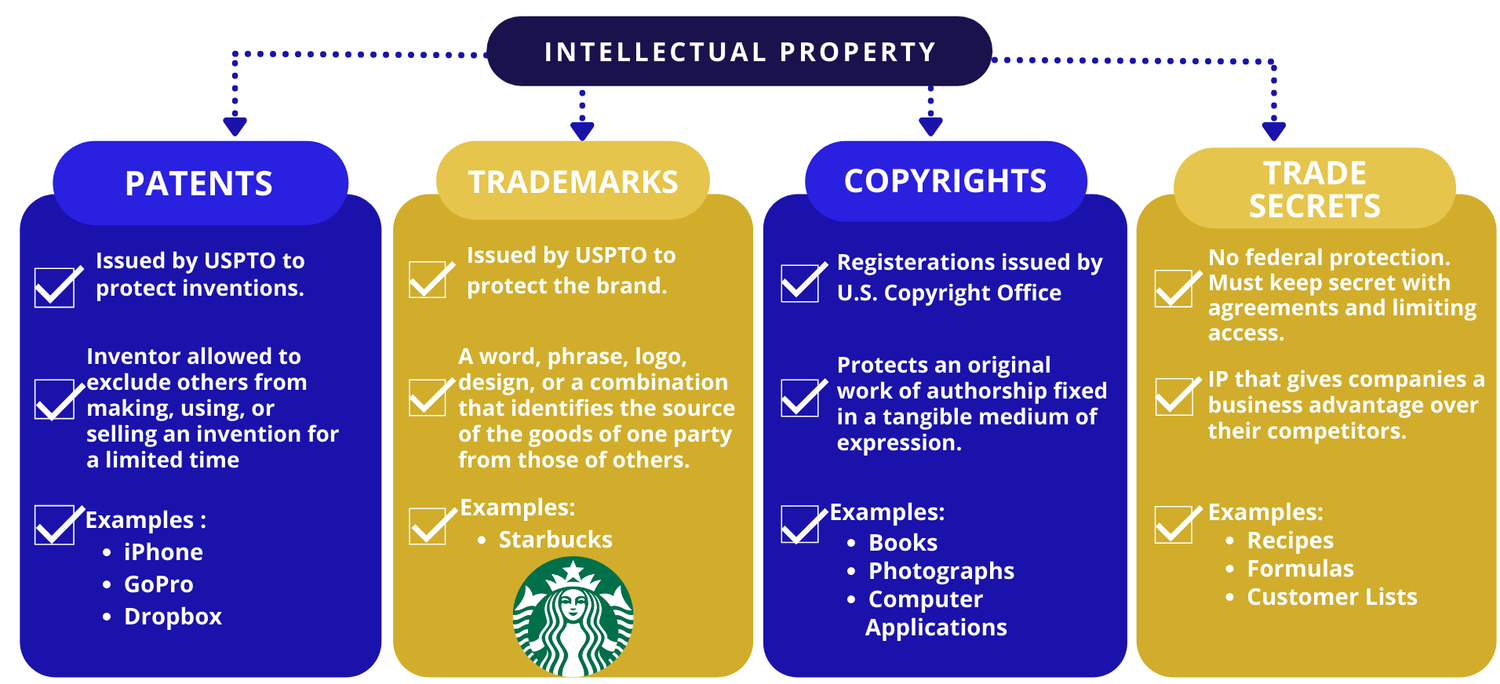
When it comes to intellectual property (IP), you may know that it has something to do with patents, trademarks, copyrights, and the often-forgotten trade secrets. All four terms describe how businesses can legally protect certain types of IP. And in case you missed our last blog:

  • Patents protect your inventions. It’s a property right given to an inventor by the U.S. PTO for a limited term. Inventors are given “the right to exclude others from making, using, offering for sale, or selling” the invention in the United States or “importing” the invention into the United States.

  • A trademark protects the brand. A registered trademark (the simplest legal definition) gives the owner of the trademark the exclusive right to use the name/brand/logo/slogan in commerce to distinguish its good and services from other businesses.

  • A copyright is the property right that protects an original work of authorship fixed in a tangible medium of expression (eg book, musical composition, etc).

  • Trade secrets protect formulas, processes, devices, techniques, methods, or other business information that companies keep private to give them a business advantage over their competitors.

Related Post: IP – The Essentials

Knowing patents, trademarks, copyrights, and trade secrets are types of IP, and what each protects is a good first step. But it doesn’t completely explain how it works as it relates to your business. Understanding that your IP is one of the most important elements of your company and that it is a business asset is critical to business operations. Therefore, it’s something you definitely want to understand, value, and protect properly.

This is particularly true during the planning and start-up phases of your business, although it’s tempting to put off thinking about IP until later. Too often, businesses wait until their operation is fully up and running, advancing through the growth phase, or when thinking about exiting your business – perhaps building it to a certain point in order to sell. Here are a few tips:

Start at the start

From the beginning you should be conscious of all of the IP you create. Keep a simple inventory of what you create, develop, invent, and what you contract with others to create on your behalf. From there you can create a strategy about what needs protection, the type of protection (more than one IP may be involved), and when to protect.

Legally secure one of the most key pieces of IP – your company name

Also, do not wait too long to legally secure one of the most key pieces of IP—your company name. When brainstorming names, you first need to check to see if any business similar to yours has already secured the name. You can do this using the USPTO electronic search system. If the name isn’t taken, you don’t have to register it right away, but you should add the ™ symbol each time you use the name in business.

Before registering, if it is registerable, you will want to do a more comprehensive search and seek legal guidance. And if you find a name that is similar more similar than not, in the same industry, be very careful about moving forward. You risk defending yourself in an infringement claim.

Be careful not to inadvertently leak your IP to others

This is true for technology startups generating innovative projects and products, creative entrepreneurs developing programs to make math fun and easy for kids, or making the next big food item to hit the shelves of Whole Foods.

All entrepreneurs should care about their IP stolen by others and take the time to file the relevant applications. It’s easy to get excited about your plans to inadvertently disclose key facts about your product or service before you actually own the IP rights.

Keep in mind what you share about your business even when you are seeking help or the financial resources to bring those plans to life.

Be mindful that all of this can affect your bottom line

This is true for technology startups generating innovative projects and products, creative entrepreneurs developing programs to make math fun and easy for kids, or making the next big food item to hit the shelves of Whole Foods. All entrepreneurs should care about their IP stolen by others and take the time to file the relevant applications.

It’s easy to get excited about your plans to inadvertently disclose key facts about your product or service before you actually own the IP rights. Keep in mind what you share about your business even when you are seeking help or the financial resources to bring those plans to life.

Check out our Intellectual Property page for more information on how we help you protect and maximize your business assets. You can also read more about Intellectual Property in Striking Business Gold, available in paperback or eBook.

Feel free to reach out to us for a consultation to get started on protecting your intellectual property.

IP – The Essentials

An asset is a resource with economic value that an individual, company, or government, owns or controls with the expectation that it will provide a future benefit. [1] So, from this simple definition, we know that what makes something an asset is that (1) it’s a resource, (2) it’s owned, and (3) it has economic value.

Intellectual property – just like the cash in your business bank account, buildings, vehicles, office equipment – is a business asset. Business owners take steps to protect their assets so that it continues to produce economic value for the business.

When it comes to intellectual property, it’s critical that you understand the IP you’ve created, or acquired full ownership of and the IP protection that is needed to protect that asset.

Related Post: What if you are not protecting your intellectual property? Find out in our previous blog, “Real Consequences.”

So, what are the different IP rights, and how do they work?

It should be clear by now that your IP is a business asset, and there are multiple ways to protect that asset. Keep in mind that what you create may need more than one type of IP protection.

For example, the Dropbox’s network synchronization is patented, and Dropbox, Inc. holds multiple trademark registrations for its products and services. Business owners should also be mindful that securing federal protection or using an NDA to protect trade secrets is not a one-time activity. Responsible business owners protect, monitor, and safeguard their IP continuously.

Check out our Intellectual Property page for more information on how we help you protect and maximize your business assets. You can also read more about intellectual property in Striking Business Gold, available in paperback or eBook.

Feel free to reach out to us for a consultation to get started on protecting your brand.

A Beginner’s Guide to Recordkeeping

In a prior blog, I discussed the importance and benefits of keeping good records as a business owner. Now, at the top of the year, I’ll go more in depth on how to create a routine around recordkeeping, which records to retain and how long, as well as the best tools to use.

First, record retention refers to the safeguarding of important records that document decisions, policies, financial activities, and internal controls[1]. It’s a key function for every business. That means you will need a system or routine for most of the records your business generates and tools to help you do it.

Related Post: Get caught up on recordkeeping at MC Law. Read our prior blog, The Importance and Benefits of Good Records.

What records do you absolutely need to retain and where do you keep them?

Certainly, the specific type of records that you will safeguard will depend on your business and those records. For example, if you sell products, you should keep records of your inventory and sales. For the most part, the records you need to retain will likely fall into one of the following categories.

Business Formation Documents

Articles of Incorporation/Certificate of Formation, Bylaws or Operating Agreement, EIN, annual meeting minutes, any licenses or permits, EIN, and all amendments to those documents should be saved in one place – preferably in a corporate record book.

Client Records

Orders, invoices, record of payments, project plans, completed project deliverables, drafts, correspondence, meeting notes,  should be stored in a customer relationship management (CRM) system. But if you are not quite ready to invest in a CRM, at the very least, store your client records in Dropbox®, Google Drive, Microsoft One Drive®, or some other cloud file hosting platform. If you are ready to invest, know that there is software that matches your business type and size.

Contracts & Agreements

Make sure to keep a copy of all leases, contractor agreements, and contracts with vendors in a place where it’s easily accessible. Signing agreements with e-signatures is pretty common now, which means you will probably be emailed a copy of the final signed document. A good habit would be to keep your electronic contracts in a dedicated folder within your Outlook or Google, AND download a PDF version and save to the cloud and/or external drive.

Business Financials

Bank statements are easily accessible online, so no need to print and store, but you should keep your account opening documents, loan documents, checks, and that folder of materials the bank will give you at account opening – in a filing system. Invest in a filing cabinet if you’re in a business that generates a lot of paper and an accordion-style folder or portable filing box if you have minimal paper to store.

Taxes

Keep your returns and all supporting documents organized by year. Set up a simple filing system for any receipts (hard copies) and store any documents sent electronically in the cloud or on an external hard drive. Eventually, you may consider springing for a scanner to store all of your paper documents to the cloud and external hard drive. Bookkeeping software is a must and will make tax time easier. Manually tracking using spreadsheets can get out of hand quickly if you are not meticulous.

samsung-hard-drive

How do you do it?

Once you identify the records you absolutely need to safeguard, you can do it by creating a routine that you will stick to. To put it simply, just do it.

Best case scenario, put the record in its proper place in real time. If you just received your copy of the final signed contract, move it to the right folder in your inbox and save the PDF to the cloud and/or your CRM.

Or pick one day a week (or at least twice a month), and block off time for to you take care of the administrative tasks that are easy to put off. One of those tasks should be ensuring that you (or someone on your team) have filed away all important documents generated that week. If once a week is too much, it’s recommended that you do this at least twice a month so that the “paperwork” doesn’t pile up.

Finally, automate wherever you can. When selecting software or tools, whether free or paid, take a look at the software integrations to determine the programs that work together to capture the information you need and make your life easier.

  For more tips on creating a record-keeping routine, and a sample record retention schedule, the SBA has an excellent guide complete with tests and discussion points to help you along the way.

At MC Law, we encourage small business owners to position themselves to avoid problems later. Check out our Business Planning page to learn how we help you have a peace of mind about the operation of your business and our Intellectual Property page for more information on how we help you protect and maximize your business assets. Or feel free to reach out to us for a consultation.

Real Consequences

We’re nearing the end of 2021, and the light at the end of the pandemic tunnel is getting brighter. One trend from this time that we won’t soon forget is the “The Great Resignation”. The reasons why employees are deciding to leave the workforce at a rate higher than usual are plenty.

For many, stay-at-home orders, long hours working from home plus homeschooling, and the general sense of uncertainty, was just the nudge they needed to take their side business seriously or to dip their toe into entrepreneurship for the first time.

If you were an employee for decades, you may have no concept of what intellectual property (IP) is and what it means for you. As an entrepreneur, understanding what IP you have and how to protect it is the key to generating revenue and building a sustainable business. What’s more, there are real consequences to doing nothing including:

1. Harder to fight copycats

It’s 2021, and it’s essentially mandatory that you have an online presence. People still visit websites to see who you are, what you’re about, and what services you offer. And social media is an easy and generally less expensive way to market your business.

The flip side of being public and developing a following is the ease in which some pretend-entrepreneurs simply watch and steal the names, slogans, and entire programs of creative entrepreneurs. Strong and secured brands put lazy copycats off.

Plus, if you have to take action, you have a stronger claim and can collect more damages.

2. Reputational Damage

Some copycats, copy word-for-word and pass it off as their own. Others copy just enough that a causal observer may believe you are the source of the “new” content.  They’re happy to ride another entrepreneurs’ coat tails.

If that copycat engages in unsavory business practices (which is likely since they steal IP) and earns a bad rap, that in turn could tarnish the goodwill you’ve built for your brand.

3. Trickier Proving You Did It First

It takes time to build a strong brand, but popularity online and relying on the fact that you have used a name, slogan, or logo for a long time may not be enough.

How do you prove that you created the IP first? Being proactive and seeking registrations for your trademarks and copyrights is generally less expensive than engaging an attorney to send a demand letter or litigate after the damage is done.

4. Lost Opportunity

If you are successful in your entrepreneurship endeavors and become profitable you will have options. You can build a business that becomes a legacy for your family, put it up for sale for a nice profit, or license your work for a fee to name a few.

Generally, interested buyers will do their due diligence around the ownership of the intellectual property because it is one of the business assets up for sale. And where or if it’s not clear what the business owns, a potential buyer may lower their offer.

If you are considering licensing your work, you want to proactively protect it and establish standards of use first.


Want to know more? Learn more about intellectual property in my new book, Striking Business Gold, written with Sasha Lalite, CEO of Meta Viable Solutions. In the book, you’ll find 17 chapters of practical legal and operational tips and strategies to help you grow your business.

One of those chapters is all about intellectual property and covers the fundamentals with clear definitions, contains examples to help you understand what you need to protect what you’ve created, warns against waiting to protect your work, and offers tips for entrepreneurs to avoid being accused of infringement. You can get your copy here.

And if you know you shouldn’t wait another day to protect your IP, schedule a consultation with us here.